Srasta Field Notes
“Predictable infrastructure cost is not a trade-off; it is a necessity for enterprise AI governance.”
By Prem Moola · June 11, 2026 · Also on Substack
**(The Hook and Thesis)**
The initial foray into enterprise AI is fundamentally an architecture-design process that can be misleading. It is easy to prototype AI by connecting a simple function call to an external API endpoint—a model that processes a prompt and returns an output. For early proof-of-concept work, this API-centric model works fine.
But the moment that functionality moves from a sandbox proof-of-concept into a revenue-generating, high-accountability production workflow, the operational assumptions crumble.
Enjoying this? Get the next one by email.
Also free: the Private AI Evaluation Checklist
The default model—treating AI simply as a series of API calls that consume tokens—becomes an unacceptable financial and operational risk. Spending is dictated by external pricing structures, unpredictable usage spikes, and vendor rate changes.
As platform leaders, our job is to bring control, governance, and predictability to systems that are inherently complex. The problem with AI today is that we are treating a core, critical operational function like a commodity utility that operates entirely off-site. We need a governed, private, and deterministic execution layer.
**(Section 2: The Variable Cost Trap: The Limitation of Token-Based Billing)**
The current paradigm for many AI implementations is based on variable, usage-based billing. Every interaction—every token consumed, every external call made—generates a line item that contributes to the final bill. While this model is fast for prototyping, it fails the test of enterprise financial planning at scale.
The key issue is that these bills measure *effort* (tokens/API calls), not *value* or *business outcome*. The cost structure is inherently opaque to platform leadership. When usage spikes due to a workflow inefficiency, a runaway agent, or an unexpected volume increase, the cost spike is immediate and, critically, *unpredictable*.
For a platform owner responsible for quarterly budgets and annual risk assessment, unpredictable expenditure is a governance failure. Relying on external APIs means ceding architectural control not only to the model provider but also to the financial variability of the service itself. We are left with a series of expensive, unaccounted-for payments, making true cost-per-business-action impossible to model or forecast.
**(Section 3: The Shift to Determinism: Controlled Infrastructure)**
The antidote to variable spend is deterministic cost modeling.
This means moving the core inference and workflow execution back onto controlled, enterprise hardware and infrastructure. This approach requires upfront investment in platform discipline—rightly so—but the payoff is structural control over spend.
Instead of optimizing for minimizing tokens, the operational focus shifts to optimizing **utilization**. With owned capacity, platform leaders can implement controls that inherently curb runaway costs:
1. **Model Routing:** Reserved expensive models only for the specific tasks that truly demand them, while routing routine tasks to smaller, cheaper, private models.
2. **Caching:** Implementing intelligent caching of repeated work and retrieval results, ensuring compute resources are not wasted on identical operations.
3. **Scaling Discipline:** Capacity can be sized and tuned relative to known operational peaks, allowing for capacity planning that aligns with predictable budgets.
The cost structure moves from an infinite, token-based variable expense to a measurable, planned infrastructure expenditure. The spend is no longer a surprise bill—it is a function of known capacity and utilization management.
**(Section 4: Governance as Cost Control: Using Srasta AI)**
Predictable infrastructure alone is insufficient. The cost control architecture must be bound by governance. This is the necessary layer between raw hardware capacity and business execution.
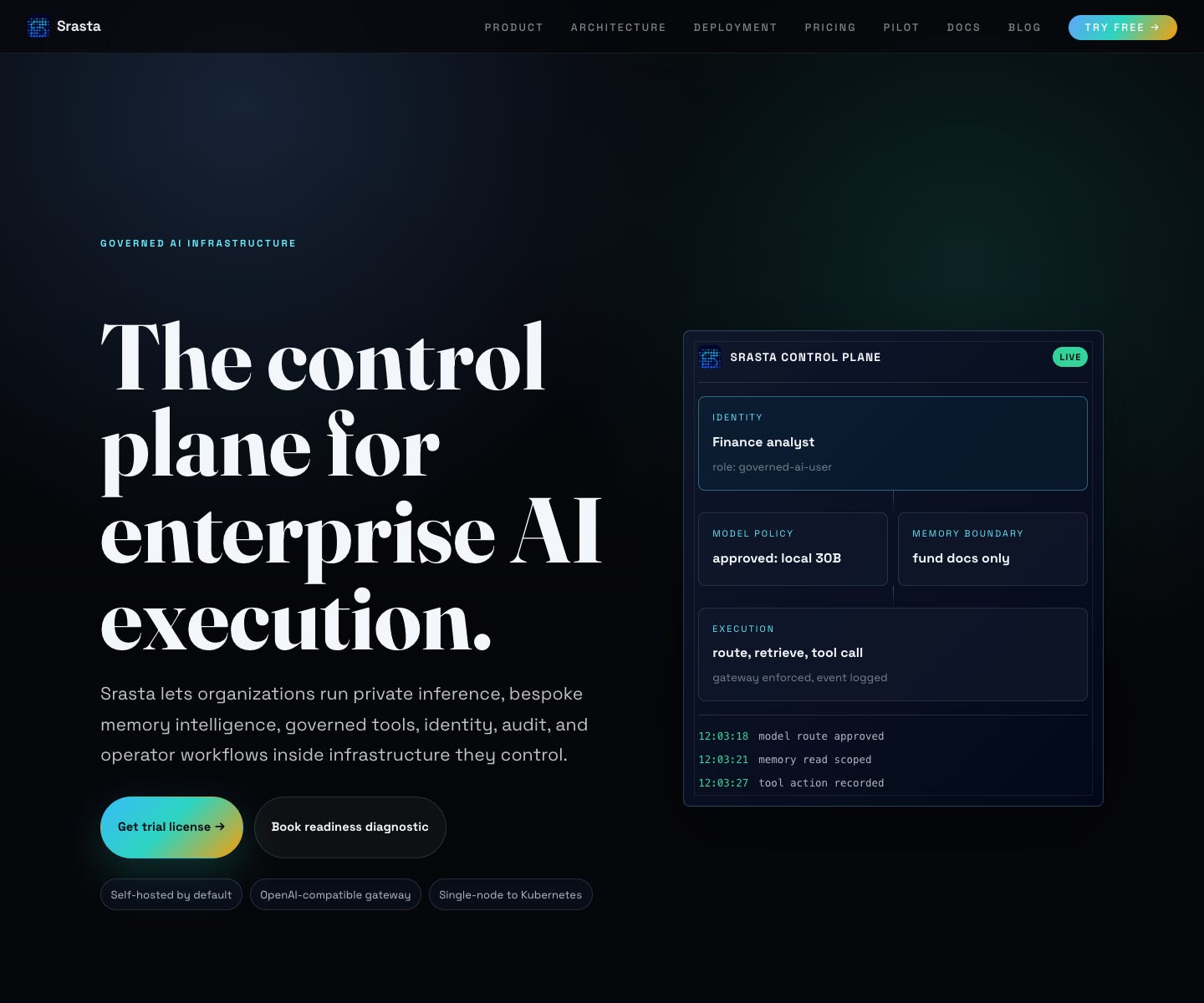
At **Srasta AI**, the focus is on building the *governed AI infrastructure*—the execution layer that enforces controls around the expensive computation. The system must ensure that every AI operation is:
* **Identity-Controlled:** Using RBAC to scope who can trigger which process.
* **Boundaried:** Enforcing company-aware boundaries on data and retrieval (governed memory), preventing cross-departmental data leakage that complicates risk and cost models.
* **Auditable:** Generating a clear audit trail that maps every inference execution back to a user action and an operator workflow.
By introducing these controls, the cost variable is fully enclosed. The cost is no longer defined by “how many tokens the model used,” but by “the deterministic, auditable cost of performing this specific, governed business action.” This ability to audit the inputs and the precise cost of the output is foundational for any large-scale, regulated enterprise.
Learn more: https://www.srasta.ai/?utm_source=substack&utm_medium=newsletter&utm_campaign=srasta-20260530&utm_content=srasta-srasta-private-ai-cost-control-compare-with-existing-unexpected-bills
#SrastaAI#AIControlPlane#AIRuntime
Keep reading
- Own the AI operating boundary
September 26, 2026
- An AI pilot should end with a decision
September 24, 2026
- Your first AI evaluation should start with a workflow
September 22, 2026